
Umatilla Parole and Probation
Oregon uses several terms for supervision after a person leaves a courtroom, county jail, or state prison. Probation is part of a court sentence. It can begin at once or follow a short Umatilla County jail term. Parole applies under particular sentencing laws and Board authority. For convictions on or after November 1, 1989, Umatilla County identifies post-prison supervision as the usual term for supervision that follows an Oregon prison sentence. The words should not be swapped, because the source of authority and the records can differ.
The Oregon Board of Parole and Post-Prison Supervision sets or administers conditions in cases within its authority. Oregon Department of Corrections records show prison and supervision status. Umatilla County Community Corrections officers perform ordinary local field supervision for probation, parole, and post-prison supervision assigned to this county. A person can therefore be out of jail and out of prison while still subject to reporting rules. That is a supervised release, not a full discharge from every sentence obligation.
| Supervision type | How it begins | Primary records | Local role |
|---|---|---|---|
| Probation | Ordered as part of a court sentence, sometimes after jail | Court judgment and later docket events | Community Corrections handles reporting and field supervision |
| Parole | Release under Board authority in a qualifying sentence | Board order, ODOC status, and release record | Local officers supervise when Umatilla County is assigned |
| Post-prison supervision | Follows a modern Oregon prison term when the judgment requires it | Judgment, ODOC status, and supervision record | The receiving county carries out day-to-day supervision |
- Discharge
- The formal end of custody or supervision under the controlling authority.
- Absconder
- A person alleged to have stopped reporting or otherwise left supervision without authorization.
- Detainer
- A request or legal hold from another authority that may prevent community release.
- Warrant
- An order authorizing arrest. It is not itself proof of a new conviction.
Note: A person may leave physical custody while parole, probation, or post-prison supervision remains active in Oregon.
Verify Umatilla Post-Release Supervision
Begin with the custody that came before release. A short Umatilla County Corrections Facility booking may lead to probation under a local court judgment. A person released from Eastern Oregon Correctional Institution or Two Rivers Correctional Institution belongs first in ODOC records. The prison’s location in Umatilla County does not prove that Umatilla County supervises the person after release. The approved release plan may assign another county.
The ODOC Offender Search can show a status and location tied to county parole or probation supervision. Read both fields with the SID and identifying details. Then compare the judgment or Board order. The Oregon court records and calendar search may show probation terms, later violations, warrants, and amended judgments. When a person is assigned locally, use the county office for the current reporting route.
- Identify whether the person left the county jail or an ODOC prison. Do not use the jail roster for an EOCI or TRCI release.
- Match the court case, full name, SID or booking number, and sentence dates. Shared names can connect the wrong record.
- Open the ODOC detail when there was a state commitment. Read status and location together rather than relying on one label.
- Review the court judgment or Board action that created supervision. A docket event can explain why the status changed.
- Contact the responsible Community Corrections office for reporting instructions. Protected case details may not be released to an unrelated caller.
The full county release transaction is obtained from the Sheriff, while an ODOC movement or discharge record comes from ODOC. The broader Umatilla County released-inmate search and records path explains how to pair custody and court proof when the prior custodian is unclear.
Umatilla County Supervision Offices
Umatilla County Community Corrections publishes offices in Pendleton and Hermiston. The correct office depends on the assignment and approved residence, not merely the arrest city. Staff assignments can change, so the official Community Corrections staff directory is safer than relying on an old officer name. The main Pendleton number is also the county’s published line for rescheduling an appointment.
Umatilla County Community Corrections
Pendleton office
4705 NW Pioneer Place
Pendleton, OR 97801
541-276-7824
Monday-Friday, 8 a.m.-5 p.m.
Lunch closure: noon-1 p.m.
Hermiston office
45 W Cherry Avenue
Hermiston, OR 97838
541-667-3041
Monday-Friday, 8 a.m.-5 p.m.
Lunch closure: noon-1 p.m.
The county lists a monthly supervision fee of $35 and says program or service fees can also apply. It also lists a $100 Community Corrections fee and a $50 Interstate Compact application fee for applicable interstate transfers. The county cautions that the fee list can change. Confirm current amounts and the payment method through the official field-supervision instructions.
An interstate move is not immediate permission to relocate. Umatilla County says that transfer can take a month or longer. A move to another Oregon county also requires instructions for that county. Until approval and reporting directions are clear, the existing order controls.
Note: Office hours and a 24-hour jail operation do not establish when a particular supervision record will update.
Umatilla Probation Release Reporting
Umatilla County gives a specific first-report rule. Someone sentenced directly to probation should report immediately after court. If the sentence requires jail first, the probationer should report immediately after release. For a weekend jail release, the published instruction is to report Monday at 8 a.m. This is a reporting deadline, not a promise that the jail releases people early for weekends.
Intake usually occurs on the first reporting day and lasts about an hour. Staff review the judgment and supervision conditions. Intake may also include a needs assessment, which helps shape services and supervision. People approved to report in another county receive directions for that county instead. Missing the first report can have serious consequences, so the released person should use the official office number if transport, illness, or another barrier affects arrival.
The county’s reporting page is the controlling public source for these local details. Its timing is unusually precise and should be read as written. It does not replace the court judgment, change the sentence, or prove that a release transaction occurred.
The official Umatilla County field-supervision source is captured below.
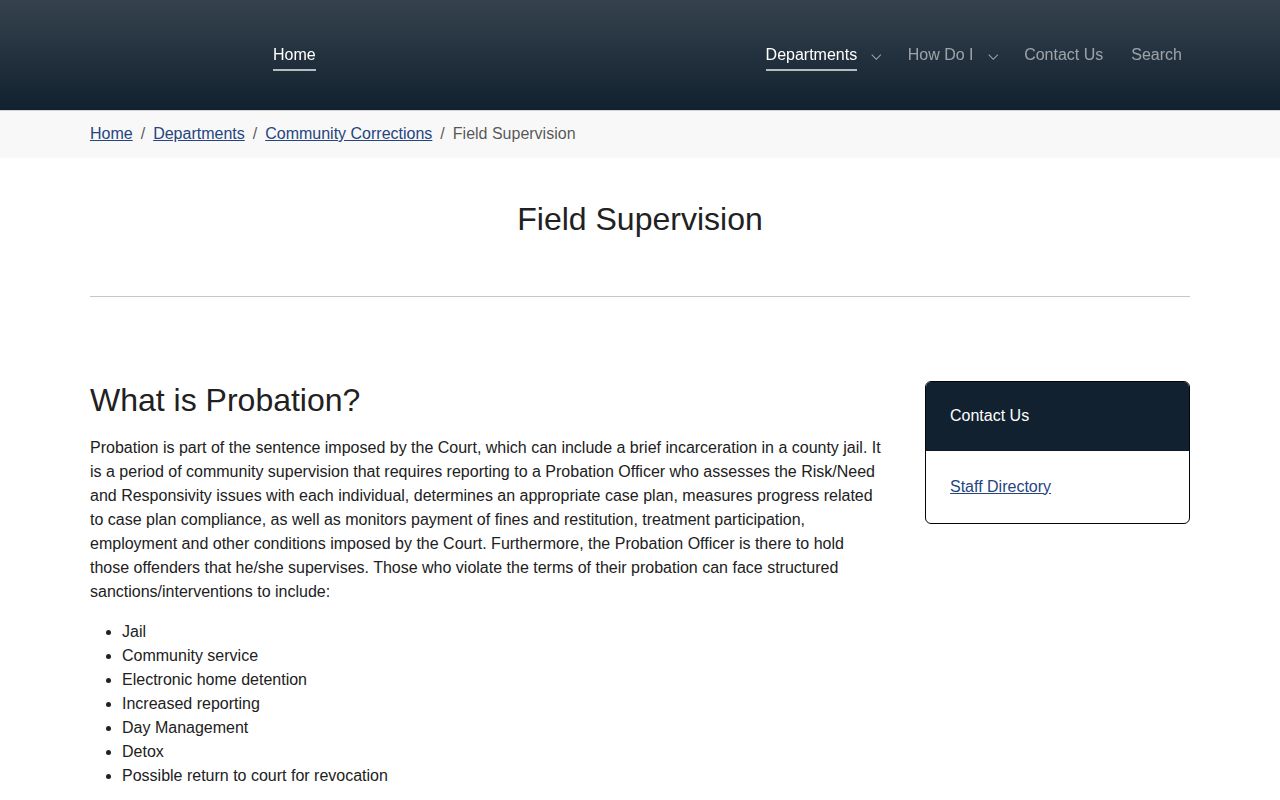
The published instructions tie the first office visit to the actual release day, while keeping the jail event and supervision intake as separate records.
Umatilla Post-Release Transition House
The county operates a 13-bed Transition House for men released from ODOC or local-control custody. It is at 4704 NW Pioneer Place. The county expressly describes the house as noncustodial and says Community Corrections does not staff it. Residents receive high-level supervision and take part in programming, but residence there is not the same as remaining in jail or prison.
This distinction matters when checking a status. A Transition House placement can coexist with parole, probation, or post-prison supervision. It should not appear as a new detention facility or be treated as proof of incarceration. The official transitional-housing page supplies the placement context, while ODOC, the court, and Community Corrections remain the sources for the legal supervision status.
Availability does not establish anyone’s destination. A release plan controls placement, and some people return to another Oregon county. Confirm the actual address and responsible office from the person’s current instructions.
Note: The Transition House is a noncustodial placement, not another Umatilla County jail or prison facility.
Umatilla Release Handoff Nearby
Three official addresses sit next to one another on NW Pioneer Place in Pendleton. The jail is at 4700, the noncustodial Transition House is at 4704, and Community Corrections is at 4705. Their proximity helps explain how local custody, a possible residential placement, and field supervision can be part of one post-release process while remaining legally distinct.
The address cluster is an inference from county directories. It does not mean every person walks from the jail to either nearby building. Someone may leave for a private residence, another county, an ODOC facility, or another custodian. Always use the release record and supervision plan to identify the actual handoff.
Umatilla Supervision Violations and Warrants
Conditions are enforceable rules in the judgment, Board order, or supervision plan. They can include reporting, approved residence, travel limits, programs, or other case-specific duties. A public summary cannot establish every condition for one person. Use the signed order and instructions issued by the supervising office.
An absconder or warrant notation is not a new release event. It may mean that the supervising authority alleges missed contact or another violation and that arrest is authorized. A Citizen RIMS warrant module, when enabled, is not a complete statewide parole list. Verify any warrant through the court and supervising agency. Do not infer absconder status from roster absence, an old post, or a missed appointment reported by someone else.
Oregon VISOR can send supported custody-event notices, but it is a notification layer. It does not replace the warrant record, court docket, Board order, or county supervision file. If a violation leads to custody, identify the new custodian before treating any later movement as a community release.
Umatilla Supervision Discharge Records
Supervision ends through the authority that controls the case. A court may complete or discharge probation. The Board can issue actions affecting parole, post-prison supervision, warrants, sanctions, inactive status, or discharge in matters within its jurisdiction. The Board is not the ordinary day-to-day field office. Umatilla County Community Corrections carries out local supervision, while ODOC and the Board retain their own records.
The Board records-request route can be used for a Board Action Form, order, minutes, or discharge action. The Board says most adult-in-custody records are retained for 25 years and most Board records for ten years. Those retention statements do not control Umatilla County’s web roster or the sheriff’s booking files.
For a final check, pair the discharge action with the current ODOC status and court docket. A clean end to supervision is different from physical release from prison, which may have happened much earlier. Conversely, leaving jail does not prove probation has ended. Accurate verification keeps those two events separate.