
No Umatilla 72-Hour Release Feed
Umatilla County's verified public interface has no rolling list of people released during the prior three days. Citizen RIMS does offer a “Last 3 Days” choice in its Arrests view. That label belongs to arrest dates. The screen has no verified release-date or release-reason field, so it cannot answer who left jail within 72 hours. The separate “Incarcerated People” view shows people listed in current custody. Neither source becomes a release feed merely because the name appears in one view or disappears from the other.
This wider inquiry should lead with the records fallback. First, identify each booking episode across the chosen dates. Then pair it with the court register and the sheriff's custody history. A person can have more than one booking, release, or court event during a three-day span. Matching the booking number, arrest date, case number, and agency prevents one event from being mistaken for another.
Build a Umatilla Three-Day Check
Set the 72-hour window before searching. Record the starting and ending date and time, especially when the span crosses a weekend. The public arrest archive can help gather possible booking episodes, but every release must be confirmed on its own. The live roster answers a present-custody question. The sheriff's release or movement line answers how and when UCSO custody ended.
- Search the UCSO arrest archive across the relevant dates and save each matching booking or case identifier.
- Check “Incarcerated People” to see whether the matching booking is still listed at the time of review.
- Open the state court record and read the register for release orders, judgments, dismissals, warrants, or amended events.
- Search Oregon VISOR for a matching custody event and compare the contributing agency.
- Contact the jail at 541-966-3632, then request the booking, custody-movement history, and release entry through the county records portal.
- Repeat the proof chain for each person rather than turning all three-day arrests into presumed releases.
The request should ask for the admission and release timestamps, the release authority or coded disposition, and the receiving agency when transferred. If the record says ODOC, another county, USMS, or ICE received the person, UCSO custody ended but community release did not necessarily occur. For a one-day review, the Umatilla County 24-Hour Release List uses a tighter same-day method.
The three-day span can contain several court systems as well. Umatilla County Circuit Court has full-service locations in Pendleton and Hermiston, while municipal matters may remain with the local municipal court. Search the court named on the case rather than assuming every arrest appears in the same register. Court data can establish the order or judgment that authorized release. The UCSO movement line remains the source for when county custody physically ended.
Umatilla 72-Hour Record Fields
A true three-day release list would need release fields, not just arrest fields. Umatilla County's public screens do not supply that full set. Use the public booking details to identify the episode, then seek the release details from the sheriff. The court record can explain legal authority, but the jail movement record normally gives the physical exit time.
| Needed field | Source and meaning |
|---|---|
| Full name and booking number | Citizen RIMS identifiers used to connect the arrest, booking, and records request. |
| Booking date and agency | Admission context; it is not a release date. |
| Charges, bail, and status | Displayed booking facts that must be read literally. |
| Case number and court events | Legal record of orders, disposition, sentence, and later changes. |
| Release date and time | Sheriff custody-history fact showing when that booking ended. |
| Release authority | Bond, recognizance, court order, time served, sentence completion, transfer, hold, or another reason. |
| Destination or recipient | Separates community release from continued custody under another agency. |
Release labels do not state the final result of the criminal case. Bond and recognizance end jail confinement under conditions. They are not acquittals. “Time served” concerns a sentence. A transfer is continued custody, and a court dismissal results in release only if no other legal basis holds the person.
Note: Ask the sheriff to define any local release code and identify the recipient named in a transfer entry.
Umatilla Weekend Release Review
A three-day span can cover Friday evening through Monday, but Umatilla County has not published a special weekend release feed or a guaranteed weekend processing rule. The county jail operates around the clock. Its public counter has posted business hours, yet those counter hours are not release hours. Do not infer that a release must occur when the public counter is open or that a holiday moves the event into a later list.
Instead, use the actual timestamp in the jail record. Court entries and VISOR events may appear on a different schedule from the custody movement. One source can lag while another has updated. When the period crosses midnight, preserve the date and local time shown by each system. A Monday court record may explain an order without proving the exact moment the person physically left custody over the weekend.
Umatilla County Community Corrections publishes one narrow weekend rule for a probationer who serves jail first: report immediately after release, or Monday at 8 a.m. after a weekend release. That is a supervision reporting instruction. It does not create a weekend release time, change a jail sentence, or show that every released person reports to Umatilla County.
Umatilla Three-Day Arrest Quirk
Citizen RIMS uses separate current-custody and arrest interfaces. Its Umatilla configuration makes arrest records available for a 30-day web age-out period and offers the two-day and three-day arrest shortcuts. Released bookings are not converted into a public release archive. Thus, the three-day filter can find an incident that began inside the review window, but it cannot tell whether that person remained jailed, posted security, finished a term, transferred, or had the booking corrected.
The official current-custody interface shows why a separate present-status check is needed.
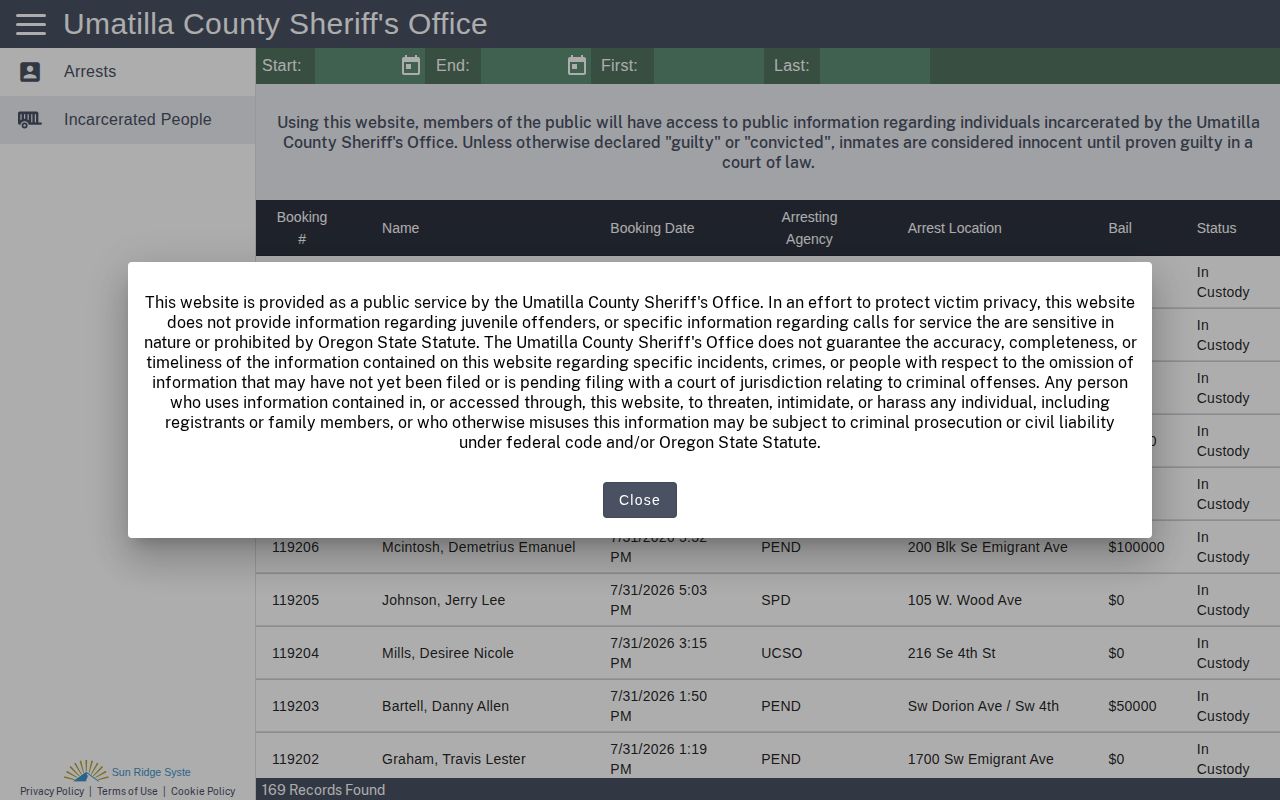
The screen can support that a booking was listed when checked, but it cannot serve as a durable three-day release archive.
The 30-day setting is also easy to misread. It controls the public arrest display, not destruction of the underlying sheriff record. No verified county source promises how long a release transaction stays online because no release archive was found. For older events, request the named booking and date range from UCSO and pair the response with the correct court case.
Note: A public-interface age-out rule and a government-record retention schedule answer different questions.
Umatilla Release Fallback Sources
Oregon VISOR is the verified notification route for supported custody events. Search by name or offender number, compare the agency and identifiers, and read the displayed event as reported. A missing VISOR result cannot distinguish release, transfer, a spelling difference, delayed data, or a record outside the system. Use the custodian's written entry when proof matters.
Custody type controls every other fallback. A county booking belongs to UCSO. A person committed to Eastern Oregon Correctional Institution, Two Rivers Correctional Institution, or another Oregon prison belongs to the ODOC Offender Search and ODOC records. A federal sentence belongs to BOP. Immigration detention belongs to ICE, and a missing ICE result is not a release certificate. No BOP or ICE detention facility was identified in Umatilla County.
For one named person, the Umatilla County released-inmate search path connects the custodian, court, notification, and records-request checks.
| Question | Use this source |
|---|---|
| Was the person listed in the county jail? | Citizen RIMS and UCSO jail reception. |
| What ended county custody? | UCSO release or movement record. |
| What order or judgment applied? | Oregon Judicial Department or the court of filing. |
| Did state-prison custody change? | ODOC Offender Search, ODOC records, and VISOR. |
| Did another authority receive the person? | The recipient named in the movement entry. |
The three-day method is intentionally cautious. It catches more possible events than a same-day view, but it also creates more chances to mix arrests, bookings, court actions, and transfers. The result is sound only when each claimed release is tied to the right booking and the agency record that ended that exact local custody episode.
For an older three-day period, do not rely on the public archive alone. Its arrest display ages out, while the underlying sheriff and court records follow separate retention rules. Give UCSO a narrow date range and the best identifiers available. If a set-aside or sealing order limits ordinary access, respect that limit and use the response from the record custodian rather than an old copy from an unofficial source.